
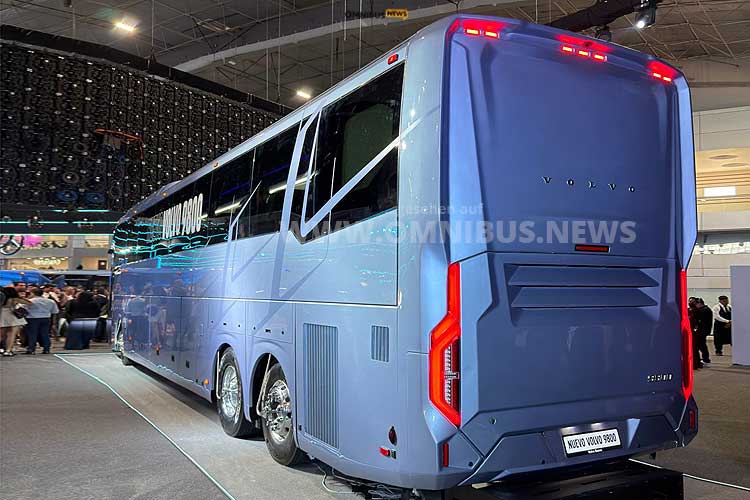
Form follows function: Das Heck des neuen Volvo 9800 verbessert den Luftwiderstandswert. Foto: Parada
Alejandro Parada, Product Development Director der Volvo Mexico Group, ist stolz auf die neue 9800er-Baureihe. Im Anschluss an die Vorstellung der neuen Reisebus-Baureihe auf der Expo Foro Movilidad 2026 postete er ein Foto des Hecks. Wie schon beim neuen MAN Lion’s Coach E und VDL Futura 3 kommt dem Heck mit Blick auf den Luftwiderstand besondere Bedeutung zu. So auch bei Volvo Buses: Das neue Design an Front und Heck, das zweifelsohne Anleihen beim Doppeldecker genommen hat und Vorbote der Formensprache für den in Mexiko für Europa produzierten 9700 sein dürfte, folgt dem Leitsatz form follows function.
Dies führe, so sagte es Rafael Kisel, Präsident der Volvo Group Mexiko, zu einem um 11% verbesserten Luftwiderstandswert. Die Form des Heckbereichs eines Omnibusses beeinflusst den Luftwiderstand maßgeblich, insbesondere den Widerstandsbeiwert und die Strömungsverteilung rund um das Fahrzeug. Das Heck erzeugt oft eine Rückströmung hinter dem Omnibus. Ein scharfes, gerades oder unruhiges Heck kann Turbulenzen und larger Wake verursachen, was den Drag erhöht. Der Drag ist der (Luft-)Widerstand, den Luft einem sich durch sie bewegenden Objekt entgegenstellt. Er entsteht durch Druck- und Reibungskräfte der Luft auf die Oberfläche des Objekts, insbesondere bei Bewegung durch die Luft.
Drag wirkt der Vorwärtsbewegung entgegen und beeinflusst Kraftstoffverbrauch, Reichweite und Fahrverhalten – um dies zu verbessern, kommt der turbulente Abströmung immer mehr Bedeutung zu. Ein abgerundetes oder abgeschrägtes Heck (Tail/looses) hilft, den Abschluss der Strömung zu erleichtern und den Wake zu verkleinern, wodurch der Luftwiderstand sinkt. Und auch eine Trennkante oder ein kleiner Spoiler am Heck kann den Abtriebswirbel reduzieren, indem er die Strömung kontrolliert und den Druckverlust minimiert – gut sichtbar beim neuen 9800. Das Heck beeinflusst auch das Strömungsverhalten um die Hinterachse, was Stabilität und Roll-Wind-Drift beeinflusst.
Bessere Stabilität kann es erlauben, Verzögerungen beim Strömungsabluss zu verringern und so den Gesamtwiderstand zu senken, die Entwickler bei Volvo Buses sprechen in diesem Zusammenhang von aerodynamischem Gleichgewicht, wie omnibus.news im Gespräch in Göteborg erfuhr. Und noch etwas muss beachtet werden: Der Luftwiderstand besteht aus Druckwiderstand (Standschock/Überdruck hinter dem Fahrzeug) und Reibungswiderstand (Schichtreibungen der Luft). Das Heck beeinflusst beide Anteile; gute Form reduziert Druckaufbau im Heckbereich und damit den Gesamtwiderstand. Kühlergriffe, Antennen, Dachrinnen etc. erhöhen lokal den Widerstand.
Eine glatte Heckfläche mit minimalen Störkanten hilft hingegen, die Luft besser um das Fahrzeug zu leiten. Kurz gesagt: Das Heck, auch beim neuen Volvo 9800 Reisebus, hat besondere Bedeutung, weil es maßgeblich bestimmt, wie die Luft hinter dem Bus abfließt. Zurück zum Design der Volvo Busse: Schon bei der Vorstellung des neuen Doppeldeckers wurde eine Formensprache von Volvo Buses in Mexiko gezeigt, die später auf die neuen 9900er und 9700er Omnibusse und damit Europa übertragen wurde. Die neue 9800er Baureihe könnte also wirklich wieder der Vorbote für den 9700er für den europäischen Markt sein. Auf Nachfrage von omnibus.news bestätigte Volvo Buses, dass der 9800 und der 9700 auf derselben Produktionslinie gefertigt werden. Wer jetzt wirtschaftlich denkt, sieht schnell Vorteile, die gemeinsame Bauteil- und Strukturähnlichkeiten ergeben könnten… (VolvoBuses/omnibus.news/Sr)
Form follows function: The rear of the new Volvo 9800 improves its aerodynamic efficiency. Photo: Parada
Alejandro Parada, Product Development Director of the Volvo Mexico Group, is proud of the new 9800 series. Following the unveiling of the new coach series at Expo Foro Movilidad 2026, he posted a photo of the rear. As with the new MAN Lion’s Coach E and VDL Futura 3, the rear is of particular importance with regard to aerodynamics. This is also true for Volvo Buses: The new front and rear design, which undoubtedly borrows from double-decker buses and is likely a precursor to the design language of the 9700 produced in Mexico for the European market, follows the principle of „form follows function.“
This, according to Rafael Kisel, President of the Volvo Group Mexico, results in an 11% improvement in the drag coefficient. The shape of a bus’s rear significantly influences aerodynamic drag, especially the drag coefficient and the airflow distribution around the vehicle. The rear often creates a backflow behind the bus. A sharp, straight, or uneven tail can cause turbulence and larger wake, which increases drag. Drag is the (air) resistance that air opposes to an object moving through it. It arises from the pressure and frictional forces of the air on the object’s surface, especially when moving through the air.
Drag opposes forward motion and affects fuel consumption, range, and handling—to improve this, turbulent airflow is becoming increasingly important. A rounded or sloping tail (tail/looses) helps to facilitate airflow closure and reduce wake, thereby lowering drag. A dividing line or small spoiler at the rear can also reduce downforce by controlling the airflow and minimizing pressure loss—clearly visible on the new 9800. The tail also influences airflow around the rear axle, affecting stability and roll/wind drift.
Improved stability can reduce delays in airflow and thus lower overall drag. Volvo Buses engineers refer to this as aerodynamic equilibrium, as omnibus.news learned in a conversation in Gothenburg. Another important factor is that air resistance consists of pressure drag (static shock/overpressure behind the vehicle) and frictional drag (layer friction of the air). The rear end influences both components; a well-shaped rear end reduces pressure buildup and therefore overall drag. Radiator handles, antennas, roof gutters, etc., increase drag locally.
A smooth rear surface with minimal disruptive edges, on the other hand, helps to better direct the airflow around the vehicle. In short: The rear end, even on the new Volvo 9800 coach, is of particular importance because it significantly determines how the air flows behind the bus. Back to the design of Volvo buses: Even at the unveiling of the new double-decker, a design language from Volvo Buses was showcased in Mexico, which was later transferred to the new 9900 and 9700 series buses and thus to Europe. The new 9800 series could therefore indeed be the harbinger of the 9700 for the European market. When asked by omnibus.news, Volvo Buses confirmed that the 9800 and the 9700 are manufactured on the same production line. Anyone thinking economically will quickly see the advantages that shared components and structural similarities could offer… (VolvoBuses/omnibus.news/Sr)