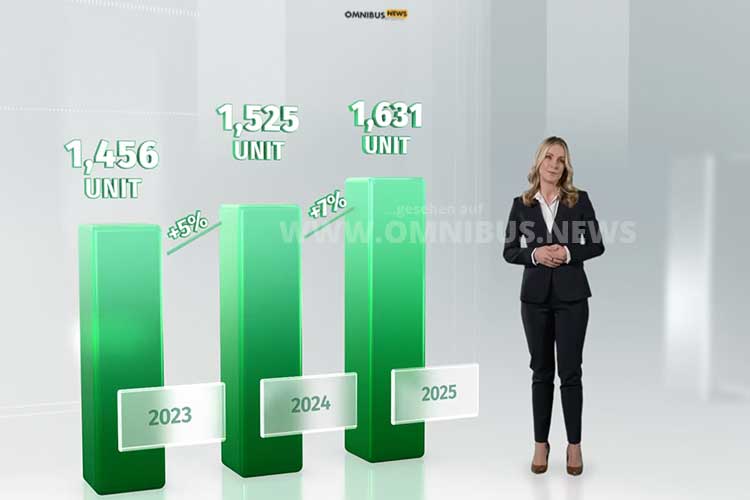
Solaris legte im Geschäftsjahr 2025 weiter deutlich zu. Foto: Screenshot Solaris
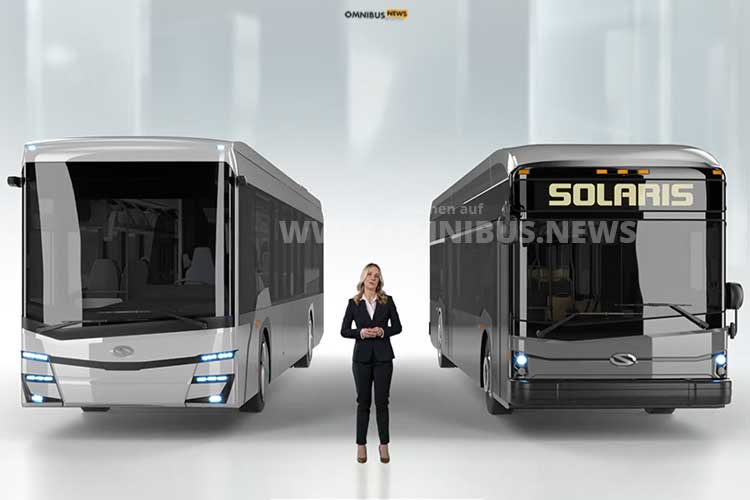
Zwei neue Baureihen standen bei der Jahresbilanzpressekonferenz im Fokus: Der neue BEV-/FCEV-InterCity und der US-Urbino- Foto: Screenshot Solaris
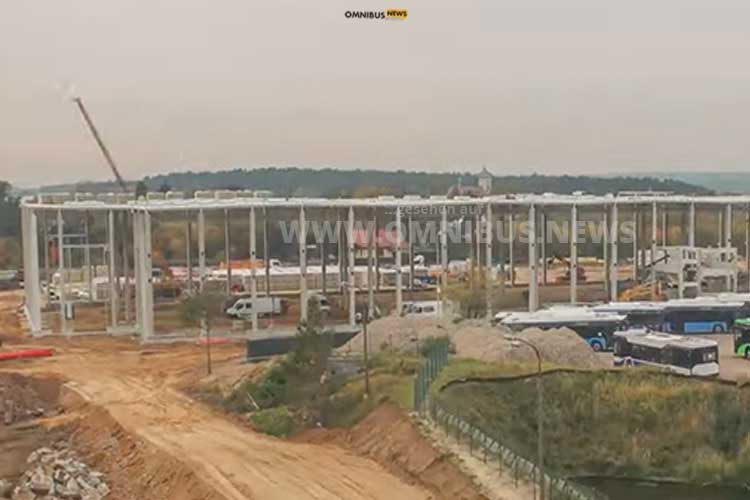
Um die prall gefüllten Auftragsbücher schnell abarbeiten zu können, wird die Produktion in Polen erweitert. Foto: Screenshot Solaris
english text below – Solaris, der polnische Bushersteller unter dem Dach der spanischen CAF Group, hat heute die Zahlen des abgelaufenen Geschäftsjahres 2025 vorgestellt. Es läuft, es läuft richtig gut! Der Branckenprimus im Segment der alternativen Antriebe meldet für 2025 in Summe 1.631 Omnibusse. 88 Prozent davon wurden mit einem alternativen Antrieb ausgeliefert, so Agata Stańda CEO von Solaris Bus & Coach. Solaris zählt dafür alle Hybrid-, BEV-, FCEV- und Trolleybusse, die im letzten Jahr produziert wurden. Tendenz weiter steigend, wie Agata Stańda mit einem Rückblick zeigte: 2020 lag der Anteil der alternativen Antriebe bei 44 Prozent, 2022 bei 55 Prozent, 2023 bei 82 und 2024 bei 83 Prozent.
Zum Earnings Before Interest and Taxes (EBIT), dem Gewinn vor Zinsen und Steuern, gab es auch nur Erfreuliches: Die betriebswirtschaftliche Kennzahl, die den operativen Erfolg eines Unternehmens darstellt, ist in den letzten drei Jahren stetig gestiegen, für 2025 nannte Agata Stańda 6,3 Prozent. Vor drei Jahren wurde das EBIT noch mit 1 Prozent kommuniziert. Nun könne man anstehende Projekte, gemeint ist u.a. die neue Baureihe der Überlandbusse aber auch die Expansion (sowohl in Europa wie auch in den USA) angehen. Bereits vor zwei Jahren hatte Solaris auf der Jahresbilanzkonferenz Pläne für den Einstieg in den nordamerikanischen Markt bekanntgegeben.
Noch im Dezember 2024 unterzeichnete Solaris erste Verträge über Buslieferungen in die USA. Die öffentlichen Verkehrsbetriebe in Seattle und Washington sowie die San Francisco Municipal Transportation Agency (SFMTA) gehören zu den ersten Kunden der speziell für den nordamerikanischen Markt modifizierten Ableger der Urbino-Baureihe. Um alle lokalen Anforderungen zu erfüllen, werde man auch in den USA produzieren. Heute nannte Agata Stańda weitere Details: Man nutze dafür die Fabrik des Mutterkonzerns. Die CAF Group baut in Elmira, New York, bekanntlich schon Schienenfahrzeuge. Nun kommen noch BEV-Busse für den nordamerikanischen Markt hinzu.
Auf Nachfrage von omnibus.news, wann denn die Produktion in den USA starte, hieß es: Eine Vorserie wolle man noch in diesem Jahr starten, die Serienproduktion beginne dann in 2027. Das bedeutet aber auch, dass die ersten Elektrobusse für die USA noch in Polen gefertigt werden. Auch würde man – entsprechend der gesetzlichen Vorgaben (Die „Buy America“-Regeln (und der strengere Buy American Act) verpflichten US-Behörden, bei öffentlichen Aufträgen und Infrastrukturprojekten (insb. Verkehr, Wasser) bevorzugt Produkte aus den USA zu kaufen. Sie fordern einen hohen Inlandsteil (2024: 65 %, bis 2029: 75 %) nur wenige Bauteile aus Polen zuliefern.
Auf die weitere Frage von omnibus.news, ob es nur BEV-Busse für den nordamerikanischen Markt geben würde, erklärte Solaris, dann man die Fahrzeuge auch als FCEV-Busse liefern werde, wenn es der Markt verlangen würde. Dass die lokal emissionsfreien Linienbusse von Solaris auch in Kanada gefragt sind, beweist ein erster (Groß-)Auftrag: Die kanadische Metropole Vancouver hat Batterie-Oberleitungsbussen bei Solaris bestellt. Zunächst geht es um 184 Fahrzeuge, es besteht aber noch eine Optionen auf weitere, mehrere Hundert Trollino-Einheiten, darunter auch Gelenkbusse.
Auch mit Blick auf das Greenhouse Gas Protocol, einem wichtigen, international anerkannten Standard zur Berechnung von Treibhausgasemissionen, meldet Solaris schon Positives: Man habe 70% bei Scope 1 und 2 sowie 63 % bei Scope 3 erreicht, die unterschiedlichen Treibhausgasemissionen im Carbon Footprint seien deutlich reduziert worden. Für das nächste Jahr kündigte Agata Stańda den Produktionsstart der neuen BEV- und FCEV-Überlandgeneration an. Und, ganz nebenbei, erwähnt sie noch, dass die nächste Urbino-Generation auch schon in Vorbereitung sei.
Solaris legt weiter zu. Auch in Polen wird aktuell an einer Erweiterung der Produktionskapazitäten gearbeitet, um die prall gefüllten Auftragsbücher schnell abarbeiten zu können. In 2025 konnte der polnische Bushersteller 2.780 Verträge zeichnen, ein Plus zum Vorjahreszeitraum von 114 Prozent. Für die APTA EXPO 2026, eine für den nordamerikanischen Markt wichtige Busmesse für den ÖPNV, kündigte Agata Stańda dann abschließend noch die Premiere des US-Urbino an, der Anfang Oktober in Chicago zu sehen sein wird. (Solaris/omnibus.news/Sr)
Solaris continued its strong growth in fiscal year 2025. Photo: Screenshot Solaris
Two new model series were the focus of the annual press conference: the new BEV/FCEV InterCity and the US Urbino. Photo: Screenshot Solaris
To quickly process the overflowing order books, production in Poland is being expanded.Photo: Screenshot Solaris
Solaris, the Polish bus manufacturer under the umbrella of the Spanish CAF Group, today presented its figures for the past fiscal year 2025. Business is booming! The industry leader in alternative drive systems reported a total of 1,631 buses delivered in 2025. 88 percent of these were equipped with an alternative drive system, according to Agata Stańda, CEO of Solaris Bus & Coach. Solaris counts all hybrid, battery electric vehicle (BEV), fuel cell electric vehicle (FCEV), and trolleybuses produced last year. The trend is continuing to rise, as Agata Stańda illustrated with a look back: in 2020, the share of alternative drive systems was 44 percent, in 2022 it was 55 percent, in 2023 it was 82 percent, and in 2024 it was 83 percent.
Solaris Bus & Coach CEO Agata Stańda explained that this figure represents a significant increase in the number of buses produced in 2020. Regarding Earnings Before Interest and Taxes (EBIT), the company’s profit before interest and taxes, the news was also positive: This key performance indicator, which represents a company’s operational success, has risen steadily over the past three years, with Agata Stańda reporting 6.3 percent for 2025. Three years ago, EBIT was reported at 1 percent. Now, the company can tackle upcoming projects, including the new series of intercity buses and expansion (both in Europe and the USA). Two years ago, Solaris announced its plans to enter the North American market at its annual results conference.
As early as December 2024, Solaris signed its first contracts for bus deliveries to the USA. The public transit authorities in Seattle and Washington, D.C., as well as the San Francisco Municipal Transportation Agency (SFMTA), are among the first customers for the Urbino series, specially modified for the North American market. To meet all local requirements, production will also take place in the USA. Today, Agata Stańda revealed further details: The company will utilize the parent company’s factory for this purpose. The CAF Group already manufactures rail vehicles in Elmira, New York. Now, they will add battery electric vehicles (BEVs) for the North American market.
When asked by omnibus.news when production would begin in the US, the company stated that a pre-series production run is planned for this year, with series production commencing in 2027. This also means, however, that the first electric buses for the US will still be manufactured in Poland. Furthermore, in accordance with legal requirements (the „Buy America“ rules (and the stricter Buy American Act) oblige US authorities to preferentially purchase products from the USA for public contracts and infrastructure projects (especially transportation and water). These rules require a high domestic share (65% by 2024, 75% by 2029) and only a small number of components to be supplied from Poland.
In response to a further question from omnibus.news as to whether only BEV buses would be available for the North American market, Solaris explained that they would also supply the vehicles as FCEV buses if the market demanded it. The fact that Solaris‘ locally emission-free city buses are also in demand in Canada is demonstrated by a first (large) order: The Canadian metropolis of Vancouver has ordered battery-powered trolleybuses from Solaris. The initial order comprises 184 vehicles, but there is an option for several hundred more Trollino units, including articulated buses.
Also with regard to greenhouse gas Solaris has already reported positive results according to the Protocol, an important, internationally recognized standard for calculating greenhouse gas emissions: They have achieved 70% for Scope 1 and 2 and 63% for Scope 3, and the various greenhouse gas emissions in the carbon footprint have been significantly reduced. Agata Stańda announced the start of production for the new generation of BEV and FCEV intercity buses next year. And, almost as an aside, she also mentioned that the next generation of the Urbino is already in development.
Solaris continues to grow. In Poland, they are currently working on expanding production capacity to quickly process their overflowing order books. In 2025, the Polish bus manufacturer signed 2,780 contracts, an increase of 114 percent compared to the previous year. Finally, Agata Stańda announced the premiere of the US-spec Urbino at APTA EXPO 2026, an important bus trade fair for the North American public transport market, which will take place in Chicago in early October. will be seen. (Solaris/omnibus.news/Sr)
Teilen auf:
Diese Website benutzt Cookies. Wenn du die Website weiter nutzt, gehen wir von deinem Einverständnis aus.