
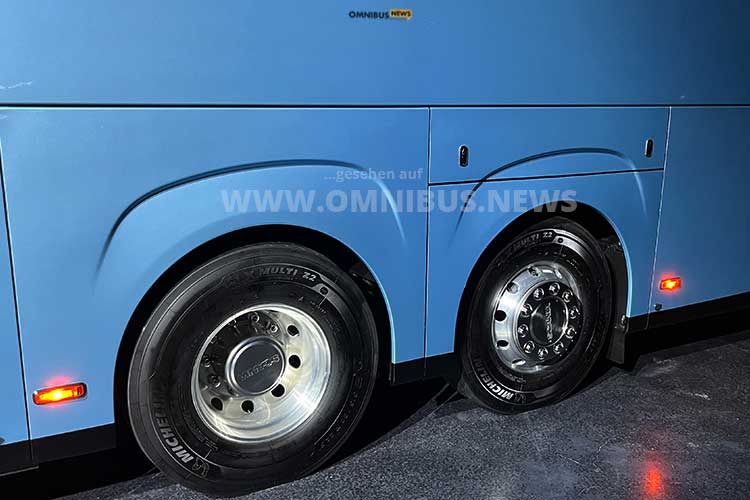
Bei der neuen Touring-Generation fällt die Form der Radkästen (wahlweise auch mit Klappe, siehe rechts) sofort auf. Foto: Schreiber
english text below – Die Radkästen des neuen Scania Touring sind nicht einfach als halbkreisförmige Ausschnitte in die Seitenwand integriert. Ihre Konturen werden durch lang gezogene, fließende und leicht nach hinten auslaufende Linien betont. Die obere Begrenzung wirkt wie eine flache, gespannte Kurve, die sich über die Räder legt und an den Enden in die horizontalen Karosserielinien übergeht. Besonders auffällig ist die Gestaltung des Bereichs zwischen den beiden Achsen: Die Radkastenkonturen bilden keine isolierten Rundungen, sondern sind optisch in die großen seitlichen Gepäckraumklappen eingebunden.
Die Linienführung setzt sich über die Klappen fort und lässt die Seitenfläche wie ein zusammenhängendes, skulpturiertes Element erscheinen. So wirkt der Bereich trotz zweier großer Räder ruhig und geordnet. Die Gestaltung ist nicht nur ein optisches Detail. Sie unterstützt mehrere konstruktive und funktionale Aufgaben: Die Radkästen müssen den Rädern einschließlich ihrer Bewegungen und der erforderlichen Freiräume Platz bieten. Ihre Form bestimmt mit, wie sich die angrenzenden Gepäckfächer und Klappen gestalten lassen. Scania nennt zusätzliche Staufächer über den Radkästen ausdrücklich als Möglichkeit, das Gepäckraumvolumen zu vergrößern.
Glatte, harmonisch ineinander übergehende Flächen helfen, abrupte Konturwechsel zu vermeiden. Das gesamte Außendesign des neuen Touring wurde laut Scania mit Blick auf einen geringeren Luftwiderstand überarbeitet. Aus dem Foto allein lässt sich allerdings nicht ableiten, welchen konkreten aerodynamischen Effekt die Radkastenkontur selbst erzielt. Die lang gezogenen Bögen lassen die Räder weniger wie nachträglich ausgeschnittene Öffnungen erscheinen. Sie verbinden die technisch notwendige Radfreistellung mit der Seitenarchitektur des Reisebusses.
Die großen Klappen oberhalb der Räder ermöglichen den Zugang zu den darunterliegenden zusätzlichen Gepäckräumen. Die klare Aufteilung der Seitenflächen unterstützt eine funktionale Gestaltung; konkrete Funktionen einzelner Klappen über die des Abschlusses eines Stauraumes gibt es nicht. Die gestalterische Besonderheit: Scania kaschiert die technische Notwendigkeit der Radkästen nicht, sondern macht sie zum Teil der Formensprache. Die flachen, nach außen gezogenen Bögen verleihen dem hinteren Seitenbereich eine dynamische Linie und verbinden Rad, Gepäckraumklappen und Karosserie optisch miteinander.
Fazit: Die Radkästen des neuen Scania Touring sind mehr als funktionale Ausschnitte in der Seitenwand. Ihre lang gezogenen, flach auslaufenden Konturen gehen fließend in die Gepäckraumklappen über und gliedern die große Seitenfläche. So verbindet Scania die konstruktiv notwendige Freistellung der Räder mit einer ruhigen, dynamischen Formensprache. Zugleich schafft die Gestaltung Raum für die neu angeordneten Gepäckfächer über den Radkästen – ein Detail, das beim Reisebus nicht nur optisch, sondern auch im täglichen Einsatz zählt. (Scania/omnibus.news/Sr)
Also available on the Touring Electric: optional small storage compartments (on the right) above the wheel arch. Photo: Schreiber
The wheel arches of the new Scania Touring are not merely integrated into the side panel as semicircular cutouts. Their contours are accentuated by elongated, fluid lines that taper off toward the rear. The upper boundary resembles a shallow, taut curve arching over the wheels, transitioning at its ends into the horizontal lines of the vehicle body. The design of the area between the two axles is particularly striking: the wheel arch contours do not appear as isolated curves but are visually integrated into the large side luggage compartment doors.
The lines continue across these doors, giving the side profile the appearance of a cohesive, sculpted element. As a result, the area retains a sense of calm and order, despite the presence of two large wheels. This design is more than just a visual detail; it serves several structural and functional purposes. The wheel arches must accommodate the wheels, including their range of motion and the necessary clearance. Their shape also dictates the design of the adjacent luggage compartments and access doors. Scania specifically highlights the potential for additional storage compartments above the wheel arches, which helps to increase total luggage capacity.
Smooth, harmoniously blending surfaces help to avoid abrupt changes in contour. According to Scania, the entire exterior design of the new Touring has been revised with a focus on reducing air resistance. However, it is not possible to determine the specific aerodynamic impact of the wheel arch contours themselves based on the photograph alone. The elongated arches ensure that the wheels do not look like mere after-the-fact cutouts; instead, they bridge the gap between the technically necessary wheel clearance and the overall architectural design of the coach.
The large doors above the wheels provide access to the additional luggage space located beneath them. The clear, structured layout of the side panels supports a highly functional design. The individual hatches serve no purpose other than to close off storage compartments. A notable design feature is that Scania does not attempt to conceal the technical necessity of the wheel arches; instead, it incorporates them into the vehicle’s overall design language. The shallow, outward-extending arches lend a dynamic line to the rear side profile, visually connecting the wheels, luggage compartment hatches, and the bodywork.
Conclusion: The wheel arches on the new Scania Touring are more than just functional cutouts in the side panel. Their elongated, low-profile contours transition seamlessly into the luggage compartment hatches, effectively structuring the large side surface. In this way, Scania combines the structurally required clearance for the wheels with a clean, dynamic design language. At the same time, this configuration creates space for newly positioned luggage compartments above the wheel arches—a detail that proves significant for a touring coach, both in terms of aesthetics and practical, day-to-day use. (Scania/omnibus.news/Sr)