
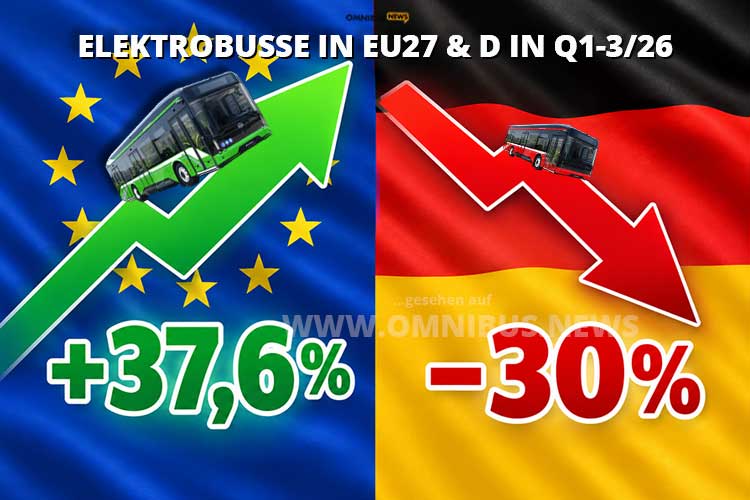
Von Januar bis September 2026 stiegen die Zulassungen elektrisch aufladbarer Busse in EU27 um 37,6 Prozent, während sie in Deutschland um 30 Prozent zurückgingen. Foto: Schreiber; Montage: omnibus.news
english text below – Die ACEA European Automobile Manufacturers’ Association (ACEA) meldet für die ersten drei Quartale 2026 einen deutlichen Anstieg der Neuzulassungen von Omnibussen in der EU27. Insgesamt verzeichne der EU-Nutzfahrzeugmarkt in den ersten drei Quartalen 2026 eine durchwachsene Entwicklung – und das vor dem Hintergrund steigender Energiepreise. Besonders stark entwickelte sich der Markt für Elektrobusse, so ACEA: Deren Neuzulassungen stiegen in den ersten neun Monaten des jahres 2026 um 37,6 %, ihr Marktanteil erhöhte sich von 22,1 % auf 26,4 %.
Italien – inzwischen der größte Busmarkt der EU – führte dieses Wachstum an, wobei sich die Zahl der Neuzulassungen dort mehr als verdoppelte. Und die klassisch angetriebenen Omnibusse? Deren Zulassungen in Q1-3/26 legten um 5 % zu, der Diesel blieb mit einem Marktanteil von 58,4 % der dominierende Antrieb. Die Neuzulassungen von Bussen in Summe in der EU sind im bisherigen Jahresverlauf um 15,2 % auf 32.695 Einheiten gestiegen, wie er Verband analysiert hat. Unter den größten Märkten verzeichnete Italien das stärkste Wachstum (+34,4 %).
Es folgt Frankreich (+10,5 %) und auf Platz 3 liegt Deutschland (+10,1 %). Auch in Spanien gab es einen Anstieg (+1,3 %), wenn auch in geringerem Tempo. Gleichzeitig verzeichnete Polen einen bemerkenswerten Zuwachs bei den Neuzulassungen um 68,6 % und ist damit zum fünftgrößten Busmarkt der EU aufgestiegen, so die ACEA. Wie sieht es im Detail in Deutschland aus? 64,5% der neuen Omnibusse in Q1-3/26 hatten einen Dieselantrieb – im Vorjahreszeitraum waren es 60,5%. Bei Elektrobusneuzulassungen sieht es genau anders aus: Für O1-3/26 waren es 15,9% der Neuzulassungen, in Q1-3/25 machten sie 25,2% aus.
Damit steht nach den ersten neun Monaten des Jahres 2025 fest: Die Zahl der neuen Elektrobusse in Deutschland ist im Vergleich zum Vorjahreszeitraum rückläufig. Und auch dem europaweiten Trend eines Plus bei Elektrobussen folgt Deutschland nicht. Die aktuellen Zahlen des europäischen Automobilherstellerverbands zeigen den Gegensatz ganz deutlich: Von Januar bis September 2026 stiegen die Zulassungen elektrisch aufladbarer Busse in EU27 um 37,6 Prozent, während sie in Deutschland um 30 Prozent zurückgingen. In Zahlen: Die Neuzulassungen gingen von 1.202 auf 836 Einheiten zurück.
Warum ist das so? PricewaterhouseCoopers (PwC) zufolge wurden 2025 in Deutschland 1.397 emissionsfreie Busse neu in Betrieb genommen, fast doppelt so viele wie 2024. Die Bundesförderung hatte maßgeblich zu diesem Schub beigetragen. Ein derart hohes Vorjahresniveau ist schwer zu übertreffen. Schon wenn Verkehrsbetriebe nach einem großen Beschaffungsjahr weniger Fahrzeuge abnehmen, sinken die Zulassungen im Jahresvergleich deutlich. Der Rückgang bei den Neuzulassungen bedeutet nicht, dass Deutschlands Elektrobusflotte schrumpft.
Laut PwC waren Ende 2025 bereits 4.752 emissionsfreie Busse im Einsatz. Im ersten Quartal 2026 lag der Bestand an batterieelektrischen Bussen laut Agora Verkehrswende bei 5.166 Fahrzeugen. Wichtig: Die Bestandszahlen und die Zulassungszahlen haben unterschiedliche Abgrenzungen und Stichtage. Sie zeigen aber, weshalb ein schwächeres Zulassungsjahr nicht mit einem Rückgang der gesamten Elektrobusflotte gleichgesetzt werden darf. Der zentrale Punkt ist deshalb: Deutschland hat 2026 weniger elektrisch aufladbare Busse neu zugelassen, obwohl die europäische Nachfrage stark wächst.
Ob daraus eine längerfristige Abschwächung entsteht, hängt vor allem davon ab, ob Fördermittel, kommunale Investitionsentscheidungen und tatsächliche Fahrzeuglieferungen wieder kontinuierlicher zusammenfinden. Die aktuell geplante Kürzung der Fördermittel für Elektrobusse für den Haushalte 2027 (geplant ist eine Verringerung des jährlichen Haushaltstitels um rund 273 Millionen Euro) kann die Erwartungen und Bestellungen beeinflussen. Sie erklärt aber nicht automatisch den bereits in den ersten neun Monaten 2026 beobachteten Zulassungsrückgang. (ACEA/Agora/PwC/PM/Sr)
From January to September 2026, registrations of electrically chargeable buses in the EU27 increased by 37.6 percent, while in Germany they fell by 30 percent. Photo: Schreiber; Montage: omnibus.news
Italy—now the largest bus market in the EU—led this growth, with the number of new registrations more than doubling. As for conventionally powered buses, registrations in the first three quarters of 2026 increased by 5%, with diesel remaining the dominant powertrain, accounting for a 58.4% market share. In total, new bus registrations in the EU rose by 15.2% year-to-date, reaching 32,695 units, the association’s analysis shows. Among the largest markets, Italy recorded the strongest growth (+34.4%).
France followed with an increase of 10.5%, while Germany ranked third with a rise of 10.1%. Spain also saw an increase (+1.3%), albeit at a more modest pace. Meanwhile, Poland experienced a notable 68.6% surge in new registrations, making it the fifth-largest bus market in the EU, according to the ACEA. What is the situation in Germany, specifically? In the first three quarters of 2026, 64.5% of new buses were diesel-powered—compared to 60.5% in the same period the previous year. The situation for new electric bus registrations is the exact opposite: they accounted for 15.9% of new registrations in the first three quarters of 2026, down from 25.2% in the same period of 2025.
Thus, after the first nine months of 2026, it is clear that the number of new electric buses in Germany has declined compared to the same period last year. Furthermore, Germany is not following the broader European trend, which has seen an increase in electric buses. Current figures from the European Automobile Manufacturers‘ Association (ACEA) highlight this contrast: from January to September 2026, registrations of electrically chargeable buses across the EU27 rose by 37.6%, while in Germany, they fell by 30%. In figures: New registrations fell from 1,202 to 836 units.
Why is this the case? According to PricewaterhouseCoopers (PwC), 1,397 zero-emission buses were put into service in Germany in 2025—nearly double the number from 2024—a surge driven largely by federal government subsidies. Surpassing such a high level from the previous year is difficult; when transport operators procure fewer vehicles following a year of major acquisitions, year-on-year registration figures inevitably drop significantly. This decline in new registrations does not mean that Germany’s electric bus fleet is shrinking.
According to PwC, 4,752 zero-emission buses were in operation by the end of 2025. Data from Agora Verkehrswende indicates that, as of the first quarter of 2026, there were 5,166 battery-electric buses in service. It is important to note that figures for the total fleet (stock) and new registrations are based on different definitions and reference dates. However, they illustrate why a weaker year for new registrations should not be equated with a decline in the total electric bus fleet. The key point is this: in 2026, Germany saw fewer new registrations of electric buses, even as demand across Europe is growing strongly.
Whether this leads to a longer-term slowdown depends primarily on whether subsidies, municipal investment decisions, and actual vehicle deliveries can once again become more consistently aligned. The currently planned reduction in subsidies for electric buses in the 2027 budget—a proposed cut of approximately 273 million euros to the annual budget line—could certainly influence expectations and orders. However, it does not automatically account for the decline in registrations already observed during the first nine months of 2026. (ACEA/Agora/PwC/PM/Sr)